

Let’s be honest, 2025 has not been easy for members of the Deaf and hard of hearing community. While Maryland’s new interpreter licensing law (which is officially on hold as of 11/19/2025, to view this announcement visit https://odhh.maryland.gov/), and was designed to protect quality and raise standards, it also magnified something we’ve known for years: there simply aren’t enough interpreters to meet demand. And in the meantime, people are suffering and more interpreters are not just around the corner.
Let’s be clear, this isn’t just a scheduling issue. This is a human rights issue.
When individuals are unable to access an interpreter (especially one that aligns with their preferences, whether in person or virtual, male or female) during their medical appointments, they are often forced to make important healthcare decisions without clear understanding. According to Greg Pollock and many others, this situation exemplifies what is known as the “Deaf Tax,” highlighting the additional challenges Deaf people face in a world that does not adequately accommodate their communication needs (you can read his article here). When there’s no interpreter available in a classroom, a student falls behind. When someone in crisis needs mental health support but can’t be understood, what’s the cost of that?
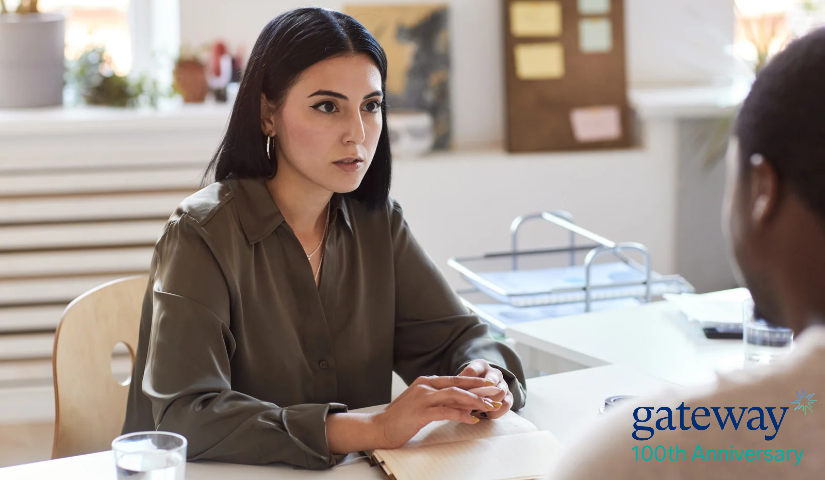
This isn’t hypothetical. At Gateway, we see the ripple effects of the interpreter shortage every day. Missed appointments. Delays in services. Deaf individuals being asked to “bring their own interpreter,” or worse, settling for ineffective alternatives like writing notes or relying on untrained staff. Communication is a basic human right. When that breaks down, so does access, safety, and dignity.
Stopgap Measures Aren’t Enough
Some agencies patch the problem with substandard solutions. They overbook interpreters, burn them out, or offer rock-bottom wages that push qualified professionals out of the field entirely. That’s not just unsustainable, it’s unethical.
Technology is another common fallback. While virtual interpreting is powerful, it’s not a cure-all. It requires stable internet, appropriate equipment, and an environment that supports privacy and connection (and the desire to use it). Too often, those conditions aren’t met. And even when they are, technology should support human connection and not replace it.
We can’t pretend the problem will fix itself. It takes real investment of time, resources, and will to address a system stretched far too thin.
So What Do We Do? We Get Scrappy.
At Gateway, we don’t wait for change, we aim to build it. We’ve doubled down on training, support, and advocacy. Our internship program is preparing the next generation of interpreters to meet both certification and state licensure requirements and the real-world demands of this work. And we’re doing it with care and urgency because the need is now.
We’re also pushing for systems-level change. That means working with policymakers to ensure the new interpreter licensing law doesn’t inadvertently lock qualified interpreters out of the field. It means advocating for Deaf community members who are still being asked to wait days or weeks for basic services. It means calling out inequities when we see them and backing up our words with action.
Interpreting Is Not a Luxury
The truth is, communication access shouldn’t be something you “hope” for, it should be something you expect. Every time an interpreter shows up, they’re not just translating words. They’re bridging lives. They’re holding space for autonomy, for trust, and for clarity. That’s not a bonus, it’s the baseline.
We’ve heard from community members who feel like their needs are being pushed to the margins. One client recently told us, “I just want to be able to go to the doctor without feeling like a burden.” That hit hard. And it’s exactly why we do this work.
Our Commitment to 2026 and Beyond
As we close out 2025, Gateway is more committed than ever to building a future where communication access isn’t a privilege, it’s a given. We will continue expanding our interpreter network, investing in our staff, and advocating for the rights of the Deaf and hard of hearing community at every level.
We know the challenges are big. But so is our mission. And if 2025 taught us anything, it’s that we’re not just ready for the work, we’re built for it.
By Dave Coyne
If you want to connect to discuss this topic further, please reach out to me at dcoyne@gatewaymaryland.org to schedule a time to meet.
Learn More About Gateway
Gateway connects people to their worlds and aids individuals in their ability to understand and to be understood. Gateway has grown into an organization that serves more than 8,000 children and adults every year, helping them communicate more effectively. With programming both on our Baltimore campus and through community-based programming, we provide education, access, and medical support to anyone who needs it.
We envision a society where everyone can understand and be understood and where everyone is treated with integrity, compassion, and equity.